
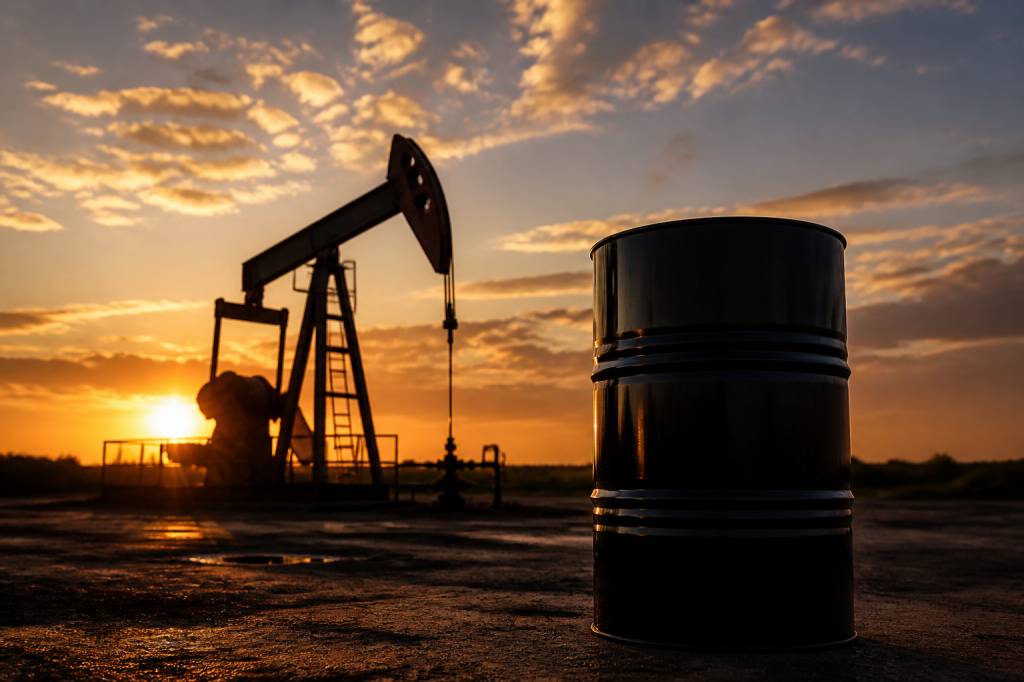
Oil remains one of the most closely watched prices in the global economy. A movement of just a few dollars per barrel can affect fuel bills, airline margins, industrial costs, inflation and even the value of national currencies. Yet the question “What is the price of one barrel of oil?” has no single answer. It depends on the benchmark, the location, the quality of the crude and the moment at which the price is observed.
For businesses and investors, the more useful question is often different: what is driving the latest oil-price trends, and what could happen next?
One barrel of oil: what exactly are we pricing?
A standard barrel contains approximately 42 US gallons, or around 159 litres, of crude oil. It is a unit of volume, not a uniform product. Crude oil varies significantly in density, sulphur content and refining requirements. That is why two barrels can trade at different prices.
The two most frequently cited international benchmarks are:
- Brent crude: the reference price for much of the oil produced and traded outside North America, particularly in Europe, Africa and the Middle East.
- West Texas Intermediate, or WTI: a benchmark for US crude, generally regarded as a high-quality, relatively light and low-sulphur oil.
Other references also matter. Dubai and Oman crude are important indicators for Asian markets, while the price of Canadian heavy oil or certain Middle Eastern grades can trade at a discount or premium to the major benchmarks.
When headlines report that “oil is trading at $80 per barrel”, they are usually referring to a futures contract for Brent or WTI rather than to a physical barrel being delivered immediately. Financial markets price oil continuously, while physical transactions involve transport, storage, insurance and quality adjustments.
Recent oil-price trends: volatility is the new normal
Oil prices have remained highly sensitive in recent years. After the extraordinary collapse of demand during the Covid-19 crisis, crude prices recovered sharply as economies reopened and consumers returned to the roads and airports. Supply disruptions, geopolitical tensions and production cuts then kept the market under pressure.
More recently, prices have moved within a broad and often unstable range rather than following a straight upward or downward path. Brent has frequently traded around the high double digits, while WTI has generally remained a few dollars lower, although the spread changes according to logistics, inventories and regional supply conditions.
Several characteristics define the current market:
- Large daily fluctuations: a single headline about a shipping route, an oil facility or a production decision can move prices within minutes.
- A narrow supply cushion: when spare production capacity is limited, even a modest disruption can have an outsized effect.
- Uneven demand: the United States remains a major consumer, while China, India and other emerging economies increasingly influence incremental demand.
- Persistent geopolitical risk: conflicts and sanctions can affect production, exports and tanker routes, even when actual supply losses remain limited.
- Greater attention to energy transition: investors and companies are assessing not only present consumption, but also the possibility of slower long-term oil demand growth.
This combination creates a market that can appear calm in the morning and considerably less calm by the afternoon. Oil, like many commodities, has a memory—but it also has a remarkably short attention span.
The supply side: OPEC+, shale and spare capacity
Supply remains the first major driver of the price of one barrel of oil. The Organization of the Petroleum Exporting Countries and its partners, commonly known as OPEC+, continue to play a central role. Production targets and voluntary cuts are designed to balance the market, support prices or prevent an excessive accumulation of inventories.
Saudi Arabia is particularly influential because it has historically maintained a significant level of spare capacity. That gives Riyadh an unusual ability to increase production when the market is tight or reduce output when prices weaken. Other major producers, including Russia, Iraq, the United Arab Emirates and the United States, also have a substantial impact on global availability.
The US shale industry adds another layer of complexity. Shale producers can respond more quickly than traditional offshore or large-scale oil projects, although the sector is not as flexible as it was once believed to be. Drilling activity depends on financing conditions, shareholder expectations, labour costs and the productivity of new wells.
High prices encourage investment and production. However, this response is not immediate. A new offshore project may require years and billions of dollars before generating its first barrel. Shale can react faster, but its output still depends on access to capital and suitable infrastructure.
The market therefore asks two practical questions: how much oil is being produced today, and how much could be produced if prices rose further? The second question is the one that determines the market’s margin of safety.
Demand: economic growth remains decisive
Oil demand is closely linked to economic activity. When factories operate at full capacity, freight volumes increase and households travel more. When growth slows, demand for diesel, jet fuel and industrial products tends to weaken.
Transport remains the largest source of oil consumption. Road vehicles account for a substantial share, but aviation and shipping are also important. This explains why economic data, employment figures and airline traffic statistics can influence crude prices almost as much as energy-specific news.
China is particularly important because it is one of the world’s largest oil importers. Its property sector, manufacturing activity and consumer spending can significantly affect expectations for global demand. A stronger-than-expected recovery may support crude prices, while weak industrial data can quickly create pressure.
India is becoming increasingly influential as well. Rising incomes, urbanisation and expanding transport networks are supporting long-term energy consumption. At the same time, efficiency gains and the growth of electric vehicles are changing the composition of demand, particularly in passenger transport.
Europe and North America face a different dynamic. Mature economies are generally seeing slower structural growth in oil consumption, although short-term demand can still rise during periods of strong travel, extreme weather or industrial expansion.
Geopolitics: the risk premium has become permanent
Oil is not traded in a political vacuum. Major production zones and critical shipping routes are concentrated in areas exposed to conflict, sanctions and diplomatic tension. As a result, prices often include a “geopolitical risk premium”: an additional amount investors are willing to pay because future supply is uncertain.
The Middle East remains central to this discussion. The region contains some of the world’s largest reserves and sits near strategic maritime routes. Any threat to production infrastructure, pipelines or tanker traffic can quickly raise concerns about supply security.
Sanctions affecting major exporters can have a similar effect. Restrictions may reduce direct exports, but the final impact depends on enforcement, buyers’ willingness to purchase sanctioned crude and the availability of alternative shipping and insurance arrangements.
The important point is that geopolitical tension does not automatically mean a dramatic price spike. Markets react most strongly when a crisis threatens physical supply. A political announcement may briefly push prices higher, but that move can fade if barrels continue to reach consumers.
For companies, the lesson is straightforward: monitoring the headline is not enough. Executives must also assess whether an event changes production, transport capacity or inventories. The distinction separates a genuine supply shock from a temporary market scare.
Inventories, interest rates and the US dollar
Commercial inventories provide one of the clearest signals of market balance. When stocks decline, traders may interpret the move as evidence of strong demand or insufficient supply. When inventories rise, the market may be signalling weaker consumption or an oversupply of crude and refined products.
US inventory data, especially reports linked to the Energy Information Administration, can therefore trigger sharp price movements. The data is not always perfect, and seasonal factors matter, but it offers a valuable snapshot of the physical market.
Interest rates also influence oil prices indirectly. Higher rates increase borrowing costs, discourage investment and can slow economic activity. They may also strengthen the US dollar, in which oil is generally priced. A stronger dollar makes crude more expensive for buyers using other currencies, potentially reducing demand.
Conversely, expectations of lower interest rates can support commodity markets. Cheaper financing may improve economic prospects and encourage investment in energy infrastructure. It can also weaken the dollar, making oil more affordable for international buyers.
This is why oil traders pay attention not only to OPEC announcements, but also to central-bank meetings, inflation reports and employment figures. The barrel of oil may be a physical object, yet its price is heavily influenced by financial conditions.
Refining margins and the difference between crude and fuel prices
A lower crude price does not always translate into cheaper petrol or diesel immediately. Refineries must process crude into fuels, and their profitability depends on the difference between the cost of crude and the selling price of refined products. This difference is known as the refining margin, or crack spread.
If refinery capacity is disrupted, petrol and diesel prices can rise even when crude prices remain stable. Seasonal maintenance, hurricanes, technical failures and changing fuel specifications can all affect the availability of refined products.
Jet fuel provides another example. Airlines are exposed not only to the price of crude, but also to the cost of refining and the availability of aviation fuel at airports. A seemingly modest change in oil prices can therefore have a disproportionate impact on ticket pricing and airline profitability.
For consumers, the relationship between crude and the price at the pump is also moderated by taxes, distribution costs and currency movements. A $5 decline in the price of a barrel will not necessarily produce an immediate or equivalent reduction in fuel prices.
What could drive the next move?
The outlook for one barrel of oil depends on competing forces. On the bullish side, supply disruptions, disciplined OPEC+ production, resilient travel demand and stronger economic growth could push prices higher. A prolonged geopolitical crisis affecting exports would add further pressure.
On the bearish side, slower global growth, rising inventories, increased non-OPEC production and a weaker-than-expected Chinese recovery could weigh on prices. Faster adoption of electric vehicles and improvements in fuel efficiency may also reduce demand growth over time.
Several scenarios deserve attention:
- Balanced market: production and consumption remain broadly aligned, keeping Brent within a relatively wide trading range.
- Supply shock: an outage or export disruption causes a rapid price increase, especially if inventories are low.
- Demand slowdown: weaker manufacturing and transport activity push prices lower as traders reassess consumption forecasts.
- Policy surprise: an unexpected OPEC+ decision, sanctions change or central-bank move generates abrupt volatility.
- Structural transition: oil demand continues to grow in some emerging markets while stagnating or declining in mature economies, producing a more fragmented market.
No single forecast should be treated as certain. Oil markets are influenced by too many moving parts, and the most confident prediction can be overturned by one unexpected disruption.
What the oil outlook means for businesses
Companies exposed to energy costs should avoid relying solely on a headline price forecast. A more robust approach combines scenario planning, sensitivity analysis and appropriate hedging.
Manufacturers can calculate how a $10 change in crude prices would affect transport, packaging and production expenses. Airlines and logistics firms may use futures or options to reduce exposure to sudden price increases. Retailers, meanwhile, should monitor how fuel costs influence consumer spending and delivery expenses.
Energy-intensive businesses should also distinguish between short-term volatility and long-term structural change. A temporary price spike may require liquidity planning. A lasting shift in energy demand may require capital investment, supplier diversification or a different business model.
For investors, the key indicators include OPEC+ policy, US shale production, global inventories, Chinese demand, refinery utilisation and the strength of the US dollar. Tracking all of them is demanding, but focusing on just one is riskier.
A market defined by uncertainty
The price of one barrel of oil is never merely a number displayed on a financial terminal. It is the result of a global negotiation between producers, consumers, refineries, governments, traders and investors.
In the short term, geopolitical events and supply decisions can dominate. Over a longer horizon, economic growth, technology, efficiency and the energy transition become more important. The most credible outlook is therefore not a single price target, but a range of scenarios and the conditions that could make each one more likely.
For businesses, the practical priority is preparation. Oil prices may be impossible to control, but their impact can be measured, monitored and managed. In a market where one headline can move billions of dollars, that discipline is worth far more than a confident guess.