


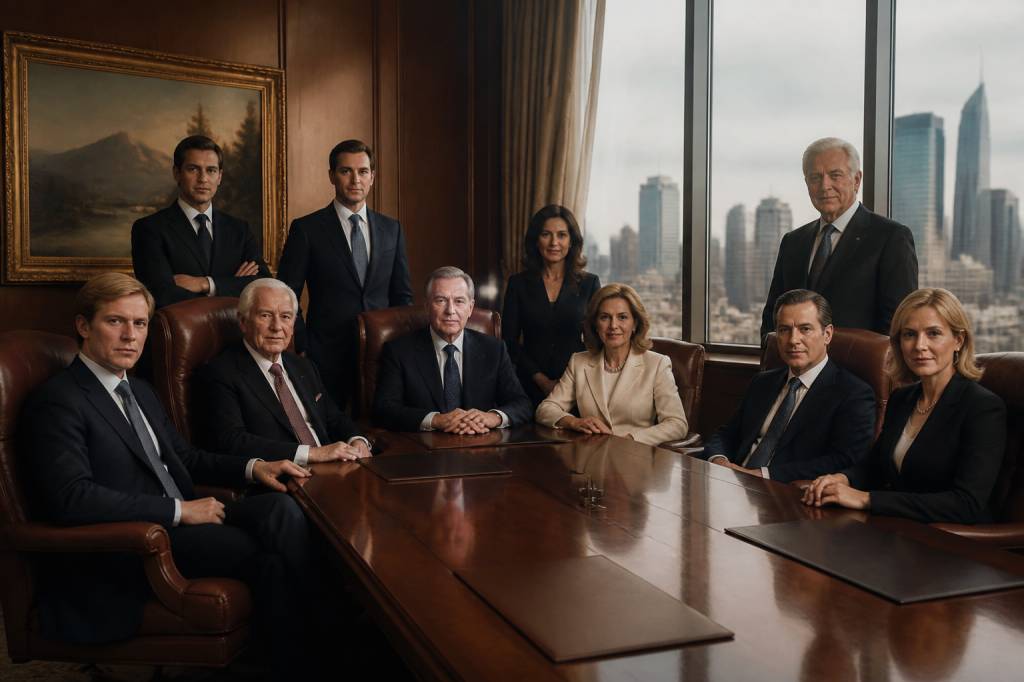
Family wealth is no longer confined to private estates, discreet boardrooms and old-fashioned family offices. It sits inside supermarkets, luxury houses, energy companies, carmakers, media groups and technology platforms used by millions of people every day.
The world’s richest families do not simply possess large bank balances. They control assets, voting rights, brands and networks that can influence entire industries. Their fortunes also reveal a great deal about how global business works: scale matters, ownership compounds, and the most valuable asset is often the ability to remain invested across generations.
Rankings vary according to market prices, exchange rates, private-company valuations and the way researchers define a “family fortune”. The figures below should therefore be read as informed estimates rather than fixed balances. A stock-market rally can add billions on paper; a regulatory decision or a weaker currency can erase them just as quickly.
The Walton family: retail power at global scale
Estimated family wealth: roughly $430 billion to $500 billion.
The Walton family remains the clearest example of how operational scale can become dynastic wealth. Sam Walton founded Walmart in 1962 with a straightforward idea: offer customers low prices, move inventory efficiently and expand relentlessly.
That formula turned a regional retailer into one of the largest companies on the planet. Today, members of the Walton family retain a substantial stake in Walmart, whose revenues are measured in hundreds of billions of dollars annually.
The family’s influence extends beyond ownership. Walmart’s decisions affect suppliers, logistics providers, food producers and consumer prices across multiple markets. Its purchasing power has helped redefine retail economics, while its investment in e-commerce and automation shows that even the world’s largest retailer cannot afford to stand still.
The lesson is pragmatic: a modest margin multiplied by enormous volume can create more wealth than a premium product sold to a smaller audience.
The Al Nahyan family: wealth built on energy and sovereign influence
Estimated family wealth: often placed above $300 billion, although estimates differ considerably.
The Al Nahyan family, ruling Abu Dhabi, occupies a distinctive position in global wealth rankings. Its fortune is associated with oil and gas reserves, but that description is incomplete. Abu Dhabi has spent decades converting energy revenues into sovereign investments, infrastructure and international assets.
The emirate is home to major investment institutions, including the Abu Dhabi Investment Authority and other state-linked vehicles. These entities hold stakes across financial services, property, technology, healthcare and industrial businesses.
That structure makes the family’s economic influence difficult to measure using conventional billionaire rankings. Not every asset is personally owned, and the line between private family wealth, ruling-family influence and sovereign capital is not always clear.
Still, the broader business strategy is unmistakable: use finite natural-resource income to build a diversified portfolio capable of generating returns long after oil is no longer the central source of growth.
The Al Saud family: a royal network with vast economic reach
Estimated family wealth: highly variable, with some estimates exceeding $100 billion and others substantially higher.
The House of Saud is one of the world’s most prominent wealthy families, but it is also one of the hardest to assess accurately. Unlike publicly listed business families, its assets are not consolidated in a single transparent corporate structure.
Saudi Arabia’s historic wealth comes from the country’s oil industry, while the modern economic strategy is increasingly shaped by Vision 2030. The programme aims to reduce dependence on hydrocarbons by investing in tourism, entertainment, technology, infrastructure and new industries.
The Public Investment Fund, Saudi Arabia’s sovereign wealth fund, has become a major global investor. It has financed domestic mega-projects and acquired stakes in companies and sports organisations around the world.
For businesses, the significance is larger than the family’s personal fortune. The Al Saud network illustrates how political authority, state capital and corporate strategy can operate together—sometimes creating opportunities, and sometimes attracting intense scrutiny over governance and transparency.
The Ambani family: India’s corporate dynasty
Estimated family wealth: around $100 billion or more, depending on market conditions.
Reliance Industries began as a textiles business founded by Dhirubhai Ambani. Under Mukesh Ambani, it evolved into one of India’s most influential corporate groups, with interests spanning energy, petrochemicals, telecommunications, retail and digital services.
Reliance’s transformation demonstrates the power of combining infrastructure with consumer technology. The launch of Jio disrupted India’s telecommunications market by offering inexpensive data and rapidly expanding smartphone access. The group then used that digital audience to support payments, entertainment, commerce and other services.
The family’s wealth is closely connected to Reliance’s share price, but the strategic story goes beyond valuation. The group has built an ecosystem in which industrial assets, retail outlets and digital platforms reinforce one another.
That approach is becoming increasingly common among large Asian conglomerates. The objective is not merely to own several businesses, but to make each business more valuable because the others exist.
The Hermes family: luxury without losing control
Estimated family wealth: roughly $150 billion to $180 billion.
The Hermes family represents a different route to dynastic wealth. There is no oil field, mass retailer or telecommunications network at the centre of the story. Instead, the family controls a significant stake in one of the world’s most prestigious luxury brands.
Founded in the nineteenth century as a harness workshop, Hermes built its reputation through craftsmanship, scarcity and a disciplined refusal to chase every passing trend. Its handbags, silk goods, watches and accessories command exceptional prices partly because supply remains deliberately constrained.
The family’s continued influence is also a governance achievement. Luxury companies can lose their identity when ownership becomes too dispersed or management prioritises short-term growth. Hermes has largely avoided that problem by preserving family shareholders’ strategic influence while allowing professional executives to run the business.
In a market obsessed with speed, Hermes offers a counterintuitive proposition: patience can be a competitive advantage. A product that takes time to make may become more valuable precisely because it cannot be produced instantly.
The Wertheimer family: the quiet owners of Chanel
Estimated family wealth: approximately $90 billion to $100 billion.
Alain and Gérard Wertheimer are best known as the owners of Chanel, one of the most recognisable names in global fashion. Their grandfather, Pierre Wertheimer, partnered with Gabrielle “Coco” Chanel in the early twentieth century, laying the foundations for a business that would become a luxury powerhouse.
Chanel’s appeal rests on a carefully managed combination of heritage, design and exclusivity. Its famous double-C logo and quilted handbags are instantly recognisable, but the company’s real asset is the strength of its brand architecture.
The family has historically maintained a low public profile. That discretion contrasts with the visibility of Chanel itself, whose products are sold across the world and whose fashion shows attract global attention.
The business demonstrates why luxury ownership can be so powerful. A strong brand does not simply sell products; it creates pricing power. When customers are buying symbolism, craftsmanship and status as well as leather or fabric, margins can remain remarkably high.
The Mars family: a confectionery empire with a private structure
Estimated family wealth: roughly $130 billion to $140 billion.
Mars began with candy and grew into a diversified consumer-goods company whose products include M&M’s, Snickers, Dove and other globally recognised brands. The company also operates in pet care, food and veterinary services.
Its privately held structure has helped the Mars family think in longer time horizons than many listed competitors. Management is not required to satisfy public shareholders every quarter, although private ownership does not eliminate pressure to innovate or remain efficient.
The family’s strategy highlights an important feature of consumer businesses: a portfolio of familiar brands can be more resilient than dependence on a single product. If consumer preferences change in one category, the group has other revenue streams to support investment.
There is also a less glamorous but highly profitable side to the Mars empire. Pet care has become a major global market, driven by rising spending on animal health, nutrition and services. The family did not remain tied to chocolate; it followed recurring consumer demand.
The Koch family: industrial wealth and ideological influence
Estimated family wealth: around $120 billion to $130 billion for the leading family branches.
Koch Industries is one of the largest privately held companies in the United States. Its activities span chemicals, energy, manufacturing, commodities, paper and other industrial sectors.
The group grew from an oil-refining business into a complex network of companies under the leadership of Charles and David Koch. Its private ownership has enabled substantial reinvestment and allowed the business to operate away from the daily rhythm of public markets.
The Koch name is also associated with political and philanthropic activity in the United States. This makes the family an example of how economic capital can translate into influence beyond the corporation itself.
From a business perspective, the important point is diversification within industrial infrastructure. These are not consumer brands that dominate headlines, but the materials, energy systems and supply chains on which other companies depend.
The Quandt family: automotive wealth behind BMW
Estimated family wealth: approximately $45 billion to $55 billion.
The Quandt family’s fortune is closely linked to its major ownership position in BMW. That stake gives the family considerable influence over one of the world’s best-known car manufacturers.
Automotive wealth is more complicated than it once was. Traditional manufacturers must finance electric vehicles, software, battery technology and new production systems while protecting margins in a fiercely competitive market.
For the Quandt family, long-term ownership provides stability during this transition. The challenge is equally clear: a powerful legacy stake is valuable only if the underlying company successfully adapts to the next era of mobility.
BMW’s position in premium vehicles offers advantages, including brand loyalty and pricing power. Yet electric-vehicle competition from established manufacturers and technology-driven newcomers is testing the entire sector. Dynastic ownership can provide patience, but it cannot replace strategic execution.
The Thomson family: media wealth in the information economy
Estimated family wealth: roughly $60 billion to $70 billion.
The Thomson family built its fortune through Thomson Reuters, a global provider of news, financial data and professional information. The company’s products are used by lawyers, accountants, banks, corporations and investors—customers who depend on reliable information in their daily work.
This is a different kind of media business. Instead of relying primarily on advertising or mass audiences, Thomson Reuters sells specialised knowledge through subscription-based services. That model can produce recurring revenues and strong customer retention when the information is difficult to replace.
The family’s history illustrates how the value of media changes when it becomes embedded in professional workflows. A headline may be consumed once; a legal database or financial terminal can become essential infrastructure.
As artificial intelligence transforms research and analysis, information companies face a major strategic question: how can they protect the value of trusted, proprietary data while customers gain access to increasingly powerful automated tools?
Why dynastic wealth continues to matter
The fortunes of these families are not identical. Some come from natural resources, others from consumer brands, industrial ownership, luxury goods or financial assets. Yet several common principles appear repeatedly.
- Ownership beats income over time. Salaries can create comfort; equity can create extraordinary wealth when a business compounds for decades.
- Control matters as much as valuation. Voting rights and family agreements can determine who shapes strategy, appoints directors and approves major transactions.
- Private structures encourage patience. Families that are not forced to report to public markets may invest through downturns, although they also face fewer external checks.
- Brand and distribution create defensive advantages. A famous luxury label, a global retail network or a trusted professional database can be difficult for competitors to replicate.
- Succession is a business issue, not a family footnote. The transfer of authority between generations can strengthen a company—or expose internal divisions.
Dynastic wealth also raises uncomfortable questions. Should economic influence be concentrated in a small number of families? How transparent should private holdings be? Where does legitimate stewardship end and political power begin?
There are no simple answers. Family ownership can protect a company from short-termism and preserve a long-term vision. It can also reduce accountability, reinforce inequality and make corporate decisions dependent on relationships that outsiders cannot easily see.
For investors, entrepreneurs and policymakers, the practical lesson is straightforward: do not look only at the wealth figure. Study the ownership structure, the source of the fortune, the governance model and the company’s capacity to adapt.
The richest families in the world are not merely beneficiaries of globalisation. They are among its architects. Their decisions influence what gets produced, distributed, financed and consumed—and their ability to think in generations rather than quarters remains one of the most powerful advantages in modern business.